ShackDeck Sign in Download Free Now

What's new

Every new feature of ShackDeck, as it ships.

QO-100 in the catalogue: the geostationary transponder through a dish you do not own 15 October 2026

The amateur transponder on Es'hail-2 hangs over Africa and is heard around the clock from Brazil to Thailand. ShackDeck now lists its beacons and the SSB, CW, FT8 and SSTV segments, tunes receivers with a dish on the satellite, and handles the converter arithmetic for you.

ShackDeck on the QO-100 PSK beacon, 10489.750 MHz, through the F6BIR receiver with a dish: the beacon and SSB signals on the waterfall

Qatar-OSCAR 100 is the first amateur transponder on a geostationary satellite: no passes, no Doppler to speak of, the same spot in the sky all day. The catch is the frequency, 10.49 GHz, which no ordinary receiver covers. A few public receivers do, through a dish and a downconverter, and that is what ShackDeck uses.

The new QO-100 rubric in the station catalogue has the PSK beacon on 10489.750 MHz, the lower and upper CW beacons that mark the transponder's edges, the SSB segment, the CW segment, the FT8 frequency, the SSTV frequency and the emergency frequency. A receiver with a dish is bound to each, the French F6BIR among them.

The converter arithmetic is taken care of: such a receiver reports its frequency offset, the program keeps the real frequency on the dial and translates it for the receiver underneath, so you tune 10489.700 and hear 10489.700. In the logbook the band is 3 cm, and a decoded FT8 station from the satellite fills the log form with the band, the frequency and the mode.

The amateur rubric got a matching line, so the satellite is one click away from the other amateur bands as well.


A catalogue of stations worth hearing, each with its own receiver 14 October 2026

More than a hundred stations in ten rubrics, from the Buzzer to weather fax and time signals, each with a story behind the "?" and a receiver that actually hears it. One click tunes the right receiver to the right frequency in the right mode.

The station catalogue: the Mystery stations rubric with the Buzzer, the Pip and the Squeaky Wheel

The station catalogue is the answer to "I have hundreds of receivers, now what do I listen to".

It holds over 130 stations in ten rubrics: mystery stations, time and frequency standards, beacons, aviation and maritime, military nets, shortwave broadcasters, medium and long wave, amateur bands and modes, one live signal for every decoder in the program, and the ISS and the QO-100 satellite. Each entry has the frequency, the mode and the passband, and a "?" that tells what the station is and why it is interesting; in the amateur rubric the same card explains FT8, WSPR, SSTV and the other modes.

Each station is bound to one receiver. The program chooses it the first time from the receivers that cover the frequency, nearest and favourite receivers first, and you can change it by hand in the station card with the spanner. Receivers whose owners set limits (a time limit, a password on part of the channels, masked bands) are marked with an hourglass in the list and are used only when nothing else hears the station.

Favourites got the same treatment: a bookmark remembers its receiver, so a saved frequency always opens where it was heard.

Record the window with the receiver's sound and your voice 14 October 2026

One button records the ShackDeck window as a video with the audio of the receiver, and, if you like, a commentary from your microphone on a second track. For a clip of a rare signal or a walkthrough for a friend.

The Video button records what you see: the whole program window at its native resolution, with the sound of the receiver mixed in. Before it starts, the program asks which microphone to use, if any, and offers two voice presets, a clean announcer voice and a radio voice with a touch of compression, so a commentary sits well next to the signal.

Stop, and the program asks where to save the file. On the Mac it is a QuickTime .mov with the receiver and the microphone as separate tracks; on Windows an .mp4 that any player opens.

The audio recording of the receiver alone, as before, is the Record button next to it: a WAV or MP3 of what you hear, with the frequency and the mode in the file name.

Weather charts by fax, APRS on the map, meteor scatter 14 October 2026

ShackDeck now decodes the DWD weather fax on 3855, 7880 and 13882.5 kHz, shows APRS stations and weather on 144.800 on the map, and decodes MSK144 meteor scatter on 6 m, 2 m and 70 cm.

ShackDeck: a weather chart received by fax, Canadian Ice Service via DWD

Three decoders arrived in one build.

Weather fax. The German weather service broadcasts surface analyses, forecasts and ice charts by radio fax several times a day. ShackDeck catches the start tone, finds the phasing, measures the line period so the chart never leans, picks up a chart that has already started, and ends the picture on the stop tone. The chart fills the window as it arrives, two lines a second, and the schedule of the next transmissions is in the station card.

APRS. On 144.800 MHz the program decodes position packets, objects and weather stations and puts them on the map with their symbols; weather stations show temperature and wind. Every packet is listed under the waterfall.

MSK144. Meteor scatter on 6 m, 2 m and 70 cm: short bursts reflected from meteor trails, decoded the way the FT8 decoder does it, with every station on the map.

Satellites: passes, Doppler, the ISS and Starlink trains 13 October 2026

A new tab tracks amateur satellites, the ISS and weather satellites over your location, with passes for the next day, azimuth and elevation, Doppler-corrected frequencies and a map of the footprint. Starlink gets a group of its own.

The Satellites tab: the ISS over the Indian Ocean with its track and footprint, the passes for the next day and the sky view

The Satellites tab answers the question every satellite operator asks first: what is over me, and when is the next pass.

Pick a satellite from the groups (amateur, ISS and stations, weather) or search it by name or NORAD number. The program shows where it is right now on the map with its footprint, and lists the passes for the next 24 hours with the rise, the maximum elevation and the set. Azimuth, elevation, range, altitude and speed update live. A sky view draws the pass as you will see it from your locator.

The transmitters of each satellite are listed with their downlink and uplink, and next to the nominal frequency stands the frequency with Doppler applied for this moment. When a public receiver covers that frequency, a Listen link opens it and keeps the Doppler correction while the satellite is over you.

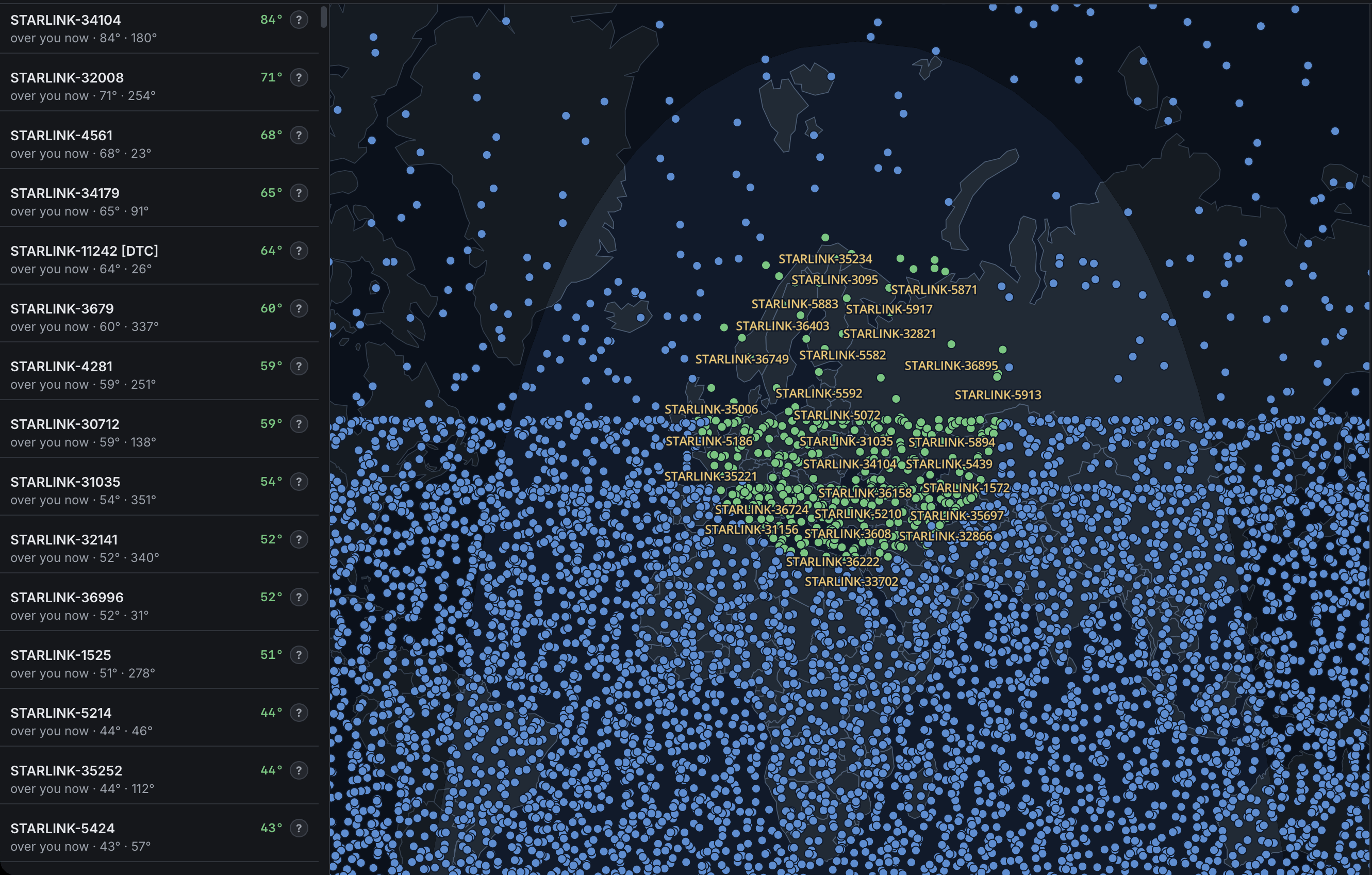
Starlink has its own group: ten thousand satellites that would blanket the map, so they are left out of "All" and shown only when you ask. After a launch the trains are a sight worth a look.

Starlink: the whole constellation on the map, the satellites over you in green

The Starlink group on the map: the satellites above you are drawn in green with their names, the rest of the constellation in blue.

A reminder ten minutes before a chosen pass, a chime at rise and set, a clock you can run forward to plan an evening, and five looks for the map: scheme, imagery, streets, night Earth and relief. Orbits come from CelesTrak and are cached, so after the first load the tab works offline.